

More Than 5,300 Empty Homes Identified in Barnet as Council Faces Housing Crisis
More than 5,300 residential properties are recorded as long-term empty in the London Borough of Barnet, despite thousands of households requiring temporary accommodation.
By Keep Updated UK
Published:
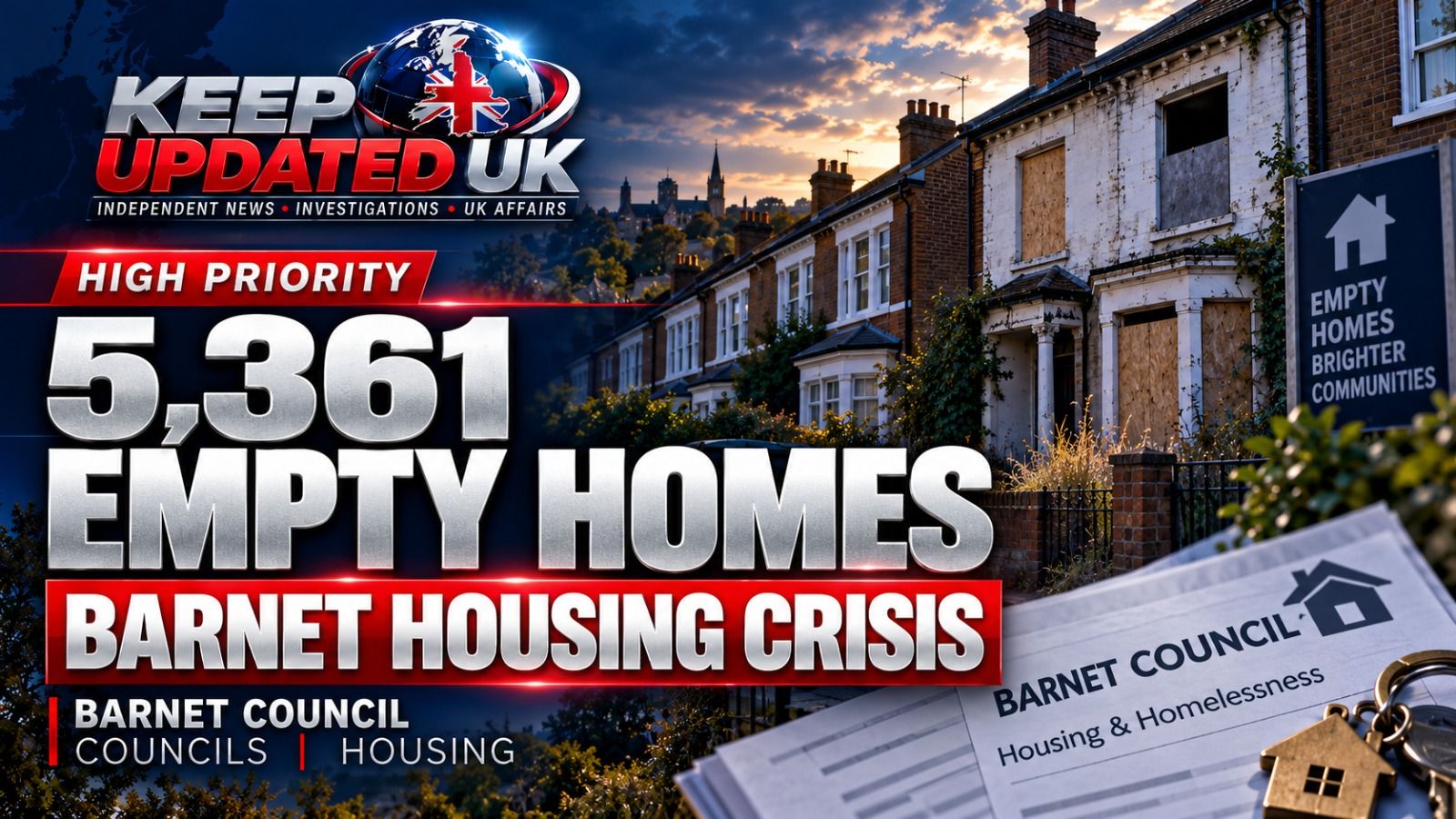
Barnet Council confirmed on 7 October that it had identified 5,361 long-term empty properties across the borough.
The figures were revealed as council officers carried out a targeted operation involving visits to 100 properties recorded as vacant.
The operation forms part of efforts to encourage owners to bring unused housing back into occupation.
Thousands of households in temporary accommodation
According to Barnet Council, more than 3,000 households were living in temporary accommodation as of July 2026.
The council says the cost of providing temporary accommodation has more than tripled since 2023, placing additional pressure on already stretched finances.
At the same time, many residential properties remain unoccupied for extended periods.
The council defines long-term empty properties for these figures as homes left unoccupied for more than six months.
At least 313 of the properties identified are going through probate, which can complicate efforts to return them to use.
What action is the council taking?
Barnet's Housing Regulatory Services team carried out visits to 100 properties to check whether they were secure and whether they presented problems such as vermin, fly-tipping or unauthorised access.
Officers also sought to explain the options available to owners wishing to return properties to use.
The authority can apply an empty-property council tax premium, potentially reaching 300% of the standard council tax charge depending on how long a property has remained vacant and the applicable rules.
Some owners may qualify for grants of up to £40,000 towards refurbishment if they agree to let their properties through the council's associated letting arrangements for five years.
The council says enforcement action can be taken where neglected empty homes cause problems and owners fail to meet their responsibilities.
Could empty homes help reduce homelessness?
Bringing suitable vacant properties back into occupation could increase available housing.
However, empty homes are not automatically available for council use. Ownership, property condition, legal restrictions and refurbishment requirements can all affect whether a home can be occupied.
The council has not claimed that all 5,361 properties could immediately house families.
Nevertheless, the figures highlight a significant issue for local authorities attempting to address homelessness while residential buildings remain unused.
The challenge is ensuring that existing housing stock is brought back into use wherever possible, while protecting the legal rights of property owners.
The council's operation took place ahead of World Vacant Homes Day on 8 October.
Keep Updated UK will examine how many long-term empty properties are successfully returned to use and whether that reduces temporary accommodation pressures.
Sources & Further Information
Related Stories

London Council Considers 150% Council Tax Increase Amid £160m Funding Crisis
Residents in a west London borough could face an unprecedented increase in council tax after Hammersmith & Fulham Council outlined financial scenarios involving rises of up to 150%.

Barnet Council Warns of £200 Million Budget Gap as Service Changes Considered
Barnet Council has published a major financial recovery plan aimed at addressing a projected £200 million budget gap between now and 2029.
Councils Struggle to Provide Safe Housing for Domestic Abuse Survivors, Survey Finds
Councils across England are facing mounting difficulties finding safe accommodation for people escaping domestic abuse, according to new research published by the Local Government Association.