

Cambridge live facial recognition trial scans 29,361 faces and leads to three arrests
Cambridgeshire Constabulary reports four positive matches and three arrests after using live facial recognition cameras in the city centre.
By Keep Updated UK Newsroom
Published:
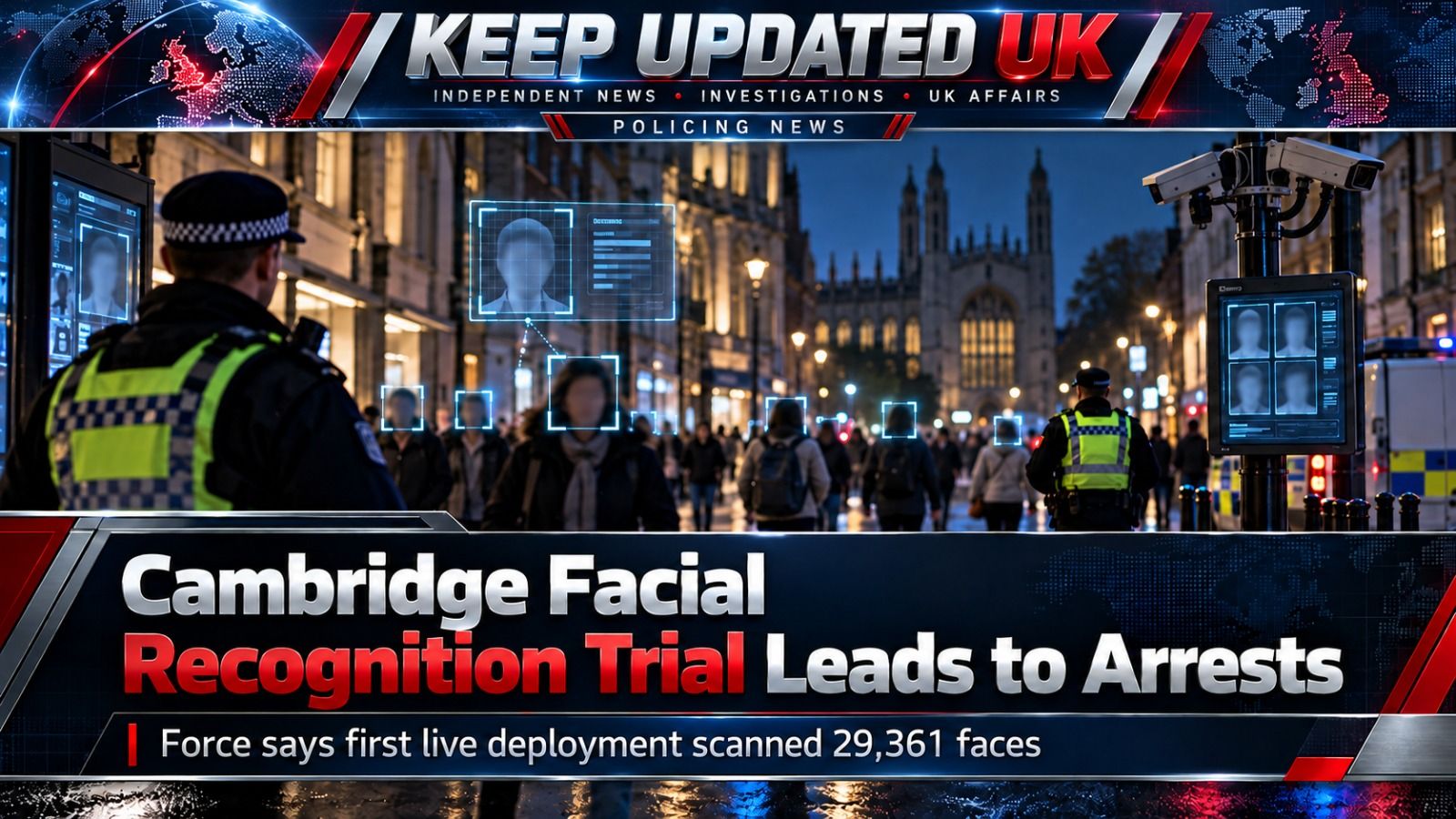
City-centre deployment
Cambridgeshire Constabulary says its first live facial recognition deployment in Cambridge resulted in three arrests after cameras scanned 29,361 faces.
The operation took place between 10am and 4pm on Friday 2 October 2026 in Market Square and Sidney Street. A police release published on 6 October says the cameras compared live images with a predefined watchlist containing 917 people.
Four alerts and three arrests
The force reported four positive matches. Two men, aged 63 and 39, were arrested because they were wanted for failing to appear. A third man, aged 52, was arrested in connection with theft and later charged with theft of a pedal cycle and theft by finding.
A match is not automatically proof of an offence: the force says alerts are checked by a trained officer before action is taken. The published figures also should not be mistaken for a claim that four arrests occurred.
How the technology works
Live facial recognition systems compare camera images with a police watchlist in near real time. Cambridgeshire Constabulary says images and biometric data for people who do not trigger an alert are deleted automatically and cannot be recovered. It also says the operation's watchlist is removed within 24 hours.
Police describe the technology as a means of locating people wanted by the courts or assessed as posing a risk. Its use nonetheless raises questions about necessity, proportionality, oversight and the impact on people going about their ordinary business.
Questions for the force
The headline figures provide one measure of operational output but not a full cost-benefit analysis. To assess the deployment, the public would also need information about equipment and staff costs, the grounds on which names were placed on the watchlist, handling of false alerts and independent assessment of safeguards.
The deployment can therefore be understood both as a police operation with reported arrests and as a subject for further scrutiny over biometric surveillance in public places.
Sources & Further Information
Related Stories
Two men arrested after suspected breach at RAF Molesworth in Cambridgeshire
Counter-terrorism detectives are investigating after two men were found inside the perimeter of RAF Molesworth following the discovery of a damaged fence.
High Court quashes warrants used in Andrew Mountbatten-Windsor police searches
Thames Valley Police has accepted that warrants used to search two properties were obtained under the wrong legal provision, while its investigation continues.
Serving Royal Navy member accused of offences involving protected information
Counter-terrorism investigators have charged a 24-year-old serving Royal Navy member over alleged conduct involving sensitive information.